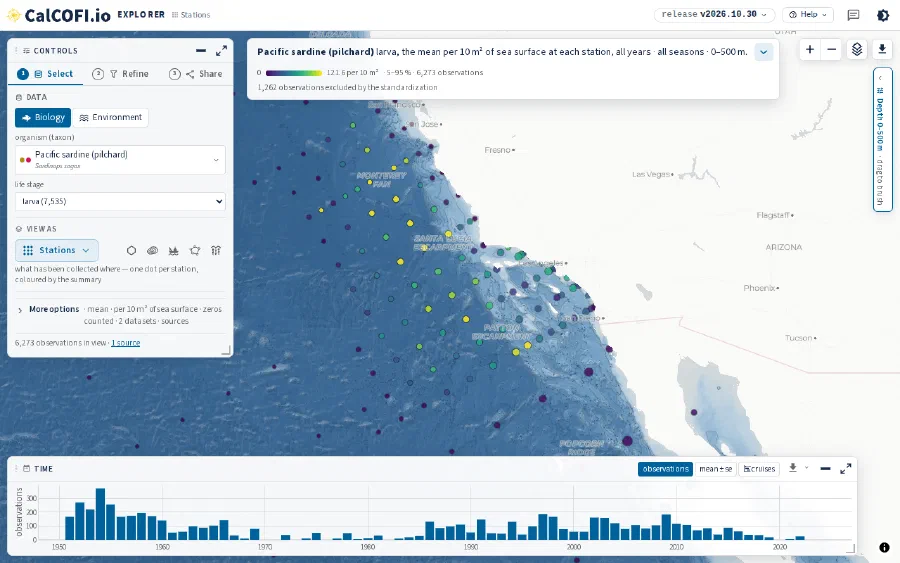
CalCOFI Explorer
One app, six lenses — stations, hexagons, contours, cruises, regions and sections — for any taxon or ocean variable in the frozen CalCOFI release, computed entirely in the browser.
TypeScriptDuckDB-WASMMapLibredeck.gl
+2
Every app, package, API, data catalog and site I build and maintain across projects — with live status and fresh screenshots.
One app, six lenses — stations, hexagons, contours, cruises, regions and sections — for any taxon or ocean variable in the frozen CalCOFI release, computed entirely in the browser.
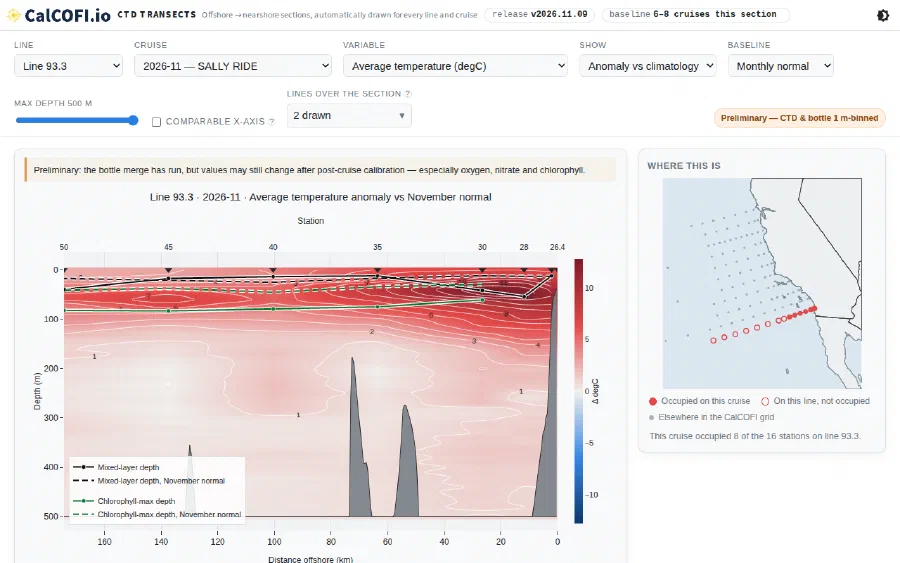
Cross-shelf sections of temperature, salinity, oxygen, density and fluorescence for every CalCOFI line and cruise since 1993, opening on the anomaly view.
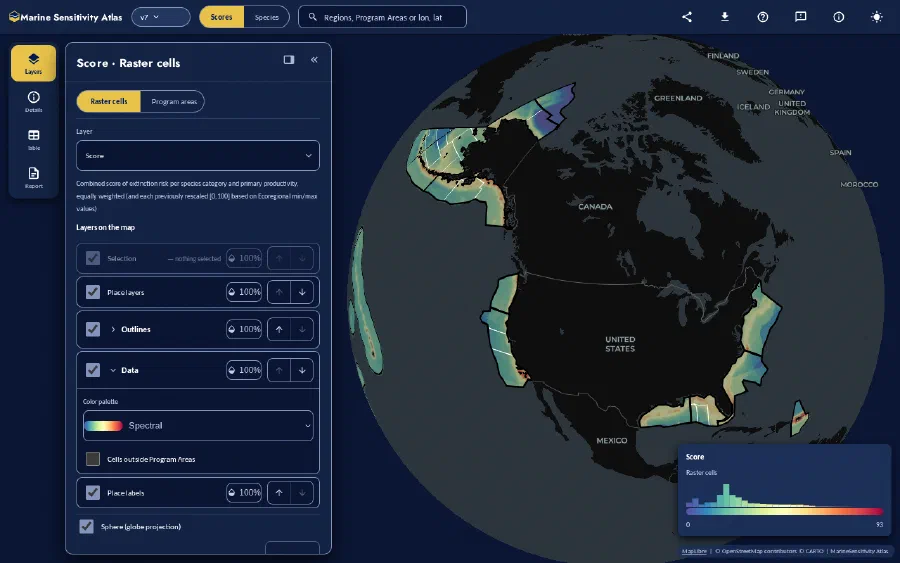
A server-free atlas of scores, species, places and reports — HTML, ZIP and DOCX export — running entirely in the browser.
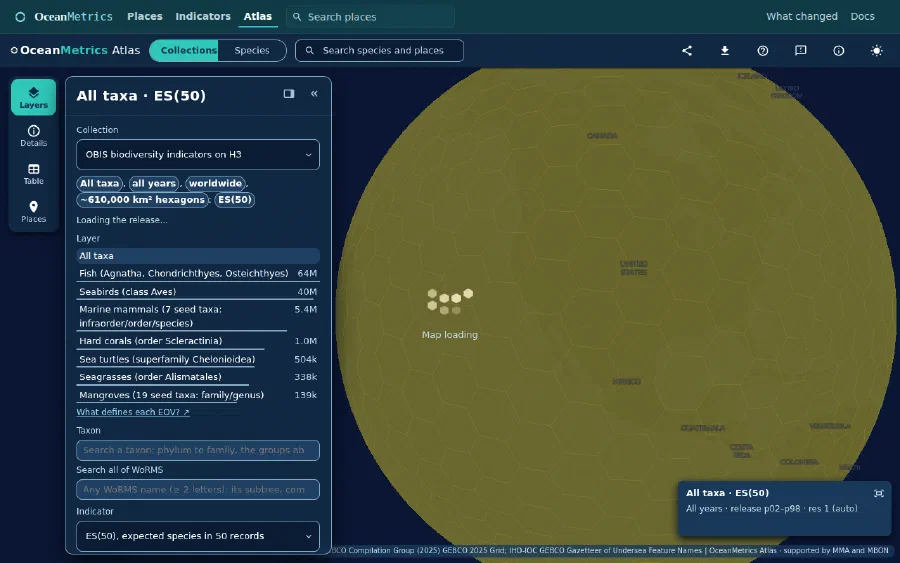
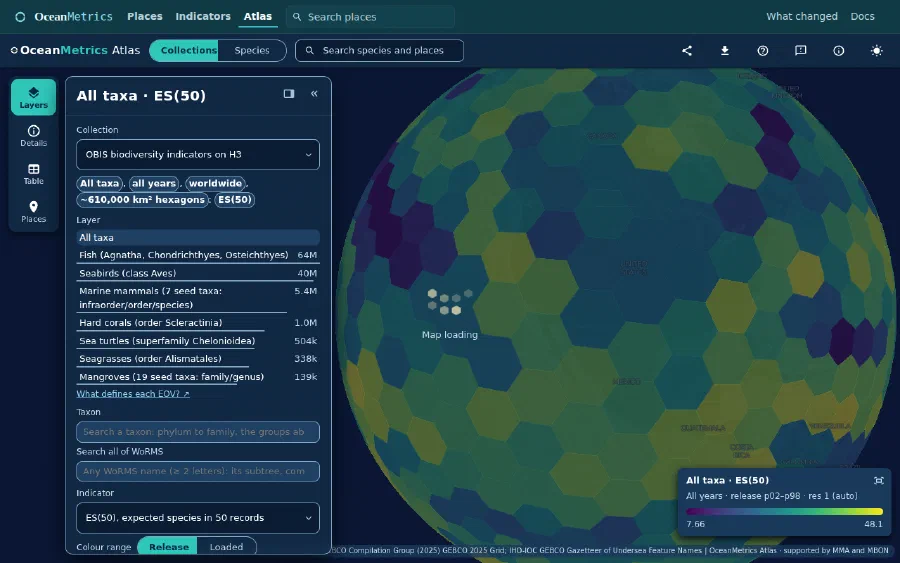
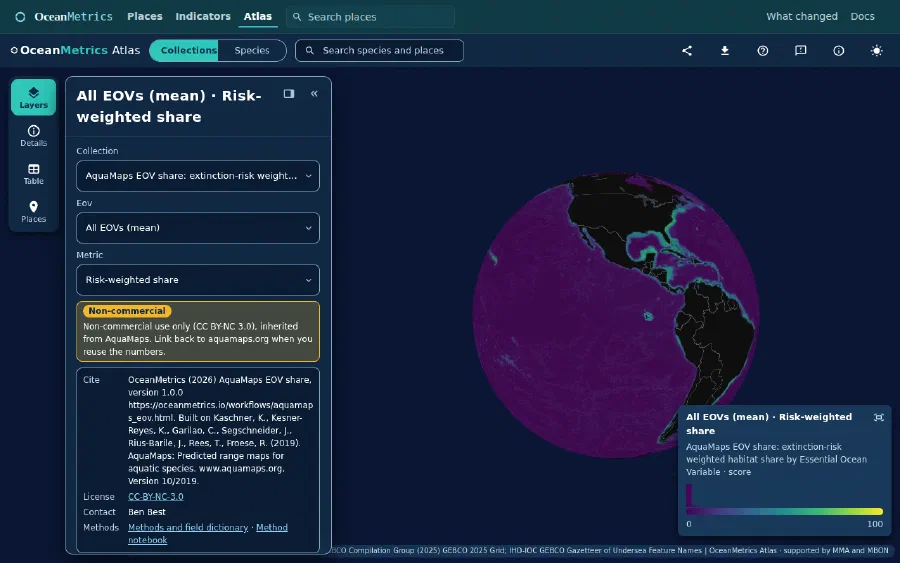
A generalized, server-free atlas that maps any species-distribution product described in a STAC catalog, with a gazetteer of places.
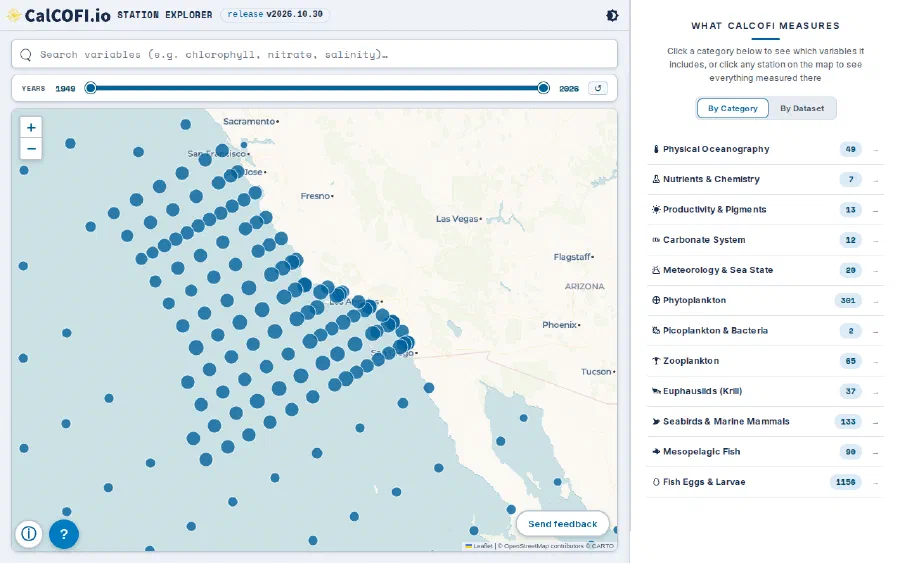
Click any CalCOFI station to see every dataset and variable ever collected there, across 75 years of cruises.
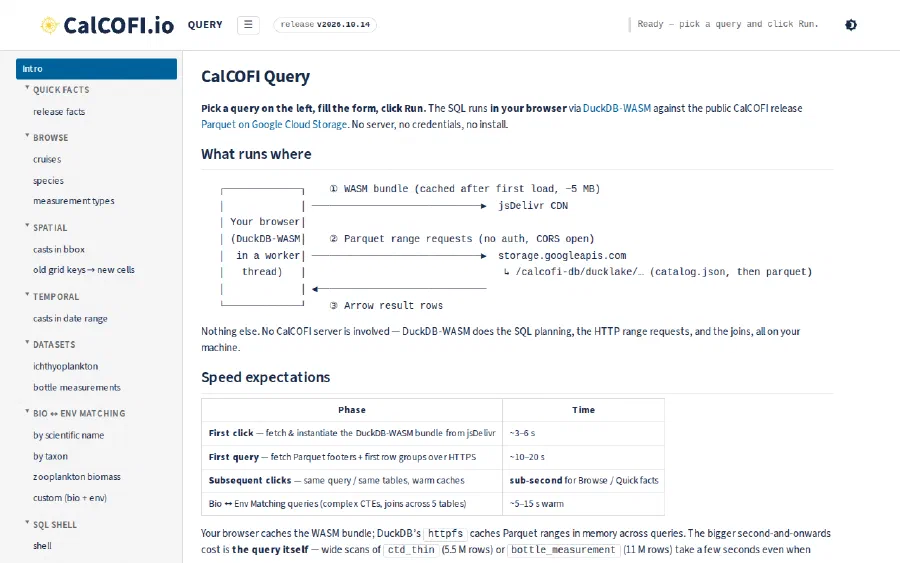
An in-browser SQL playground over the CalCOFI release — write a query, run it against Parquet with DuckDB-WASM, download the result.
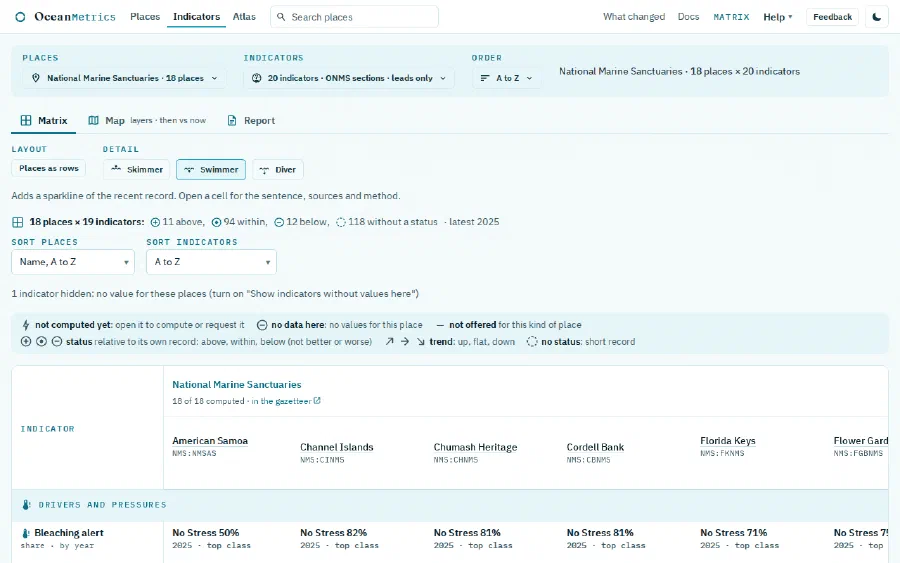
Place-based statistics from any ERDDAP grid — sanctuaries, marine regions and more — computed in the browser.
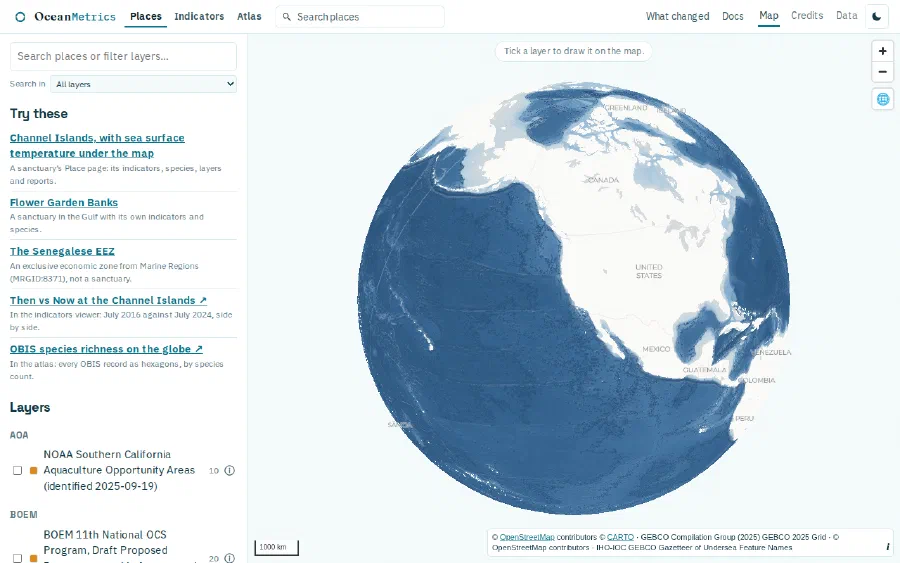
One STAC catalog of marine place layers — sanctuaries, marine regions, planning areas — with stable identifiers, licences and H3 membership.
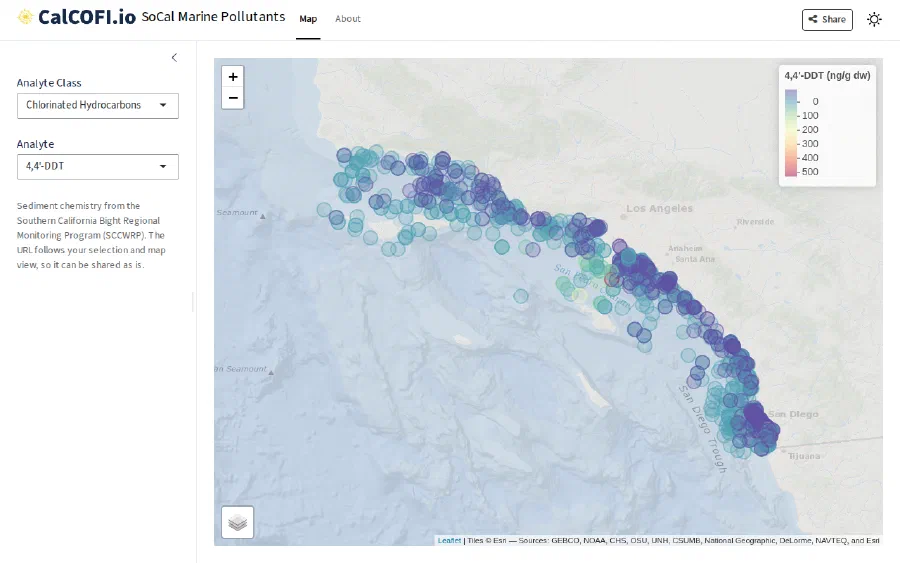
Explore DDT, PFAS and microplastics measured in CalCOFI samples, in partnership with regional monitoring programs.
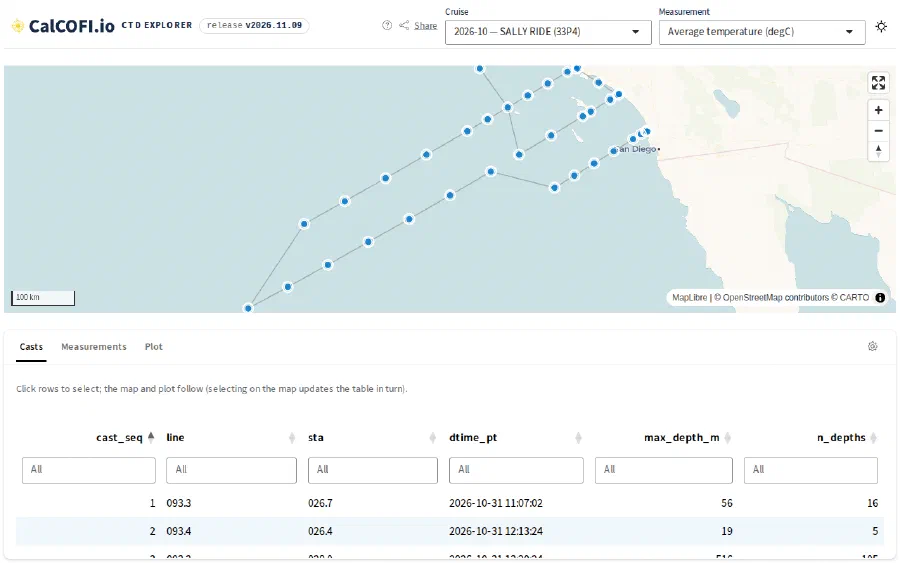
CTD profiles and maps by cruise, station and depth, with a transect you define by clicking stations on the map.
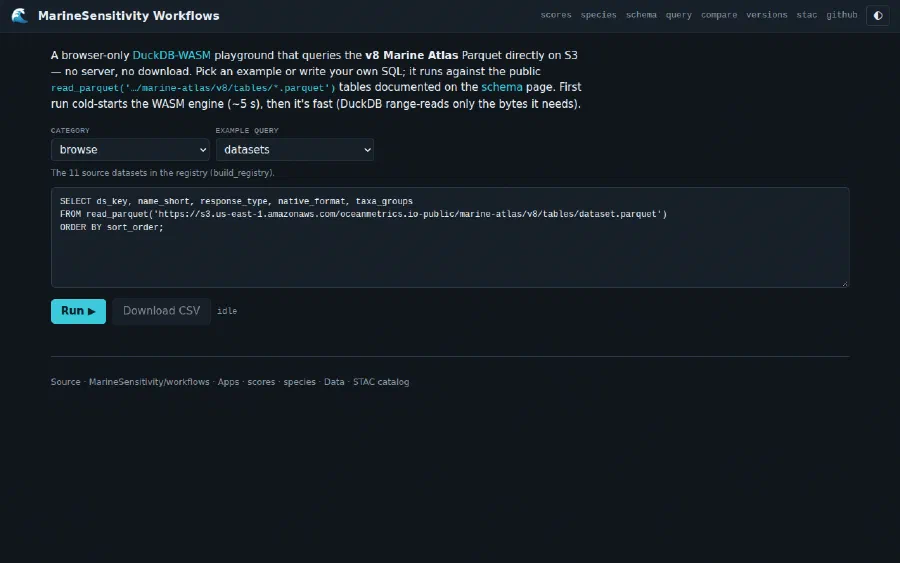
Run SQL in the browser against the published Marine Sensitivity release tables.
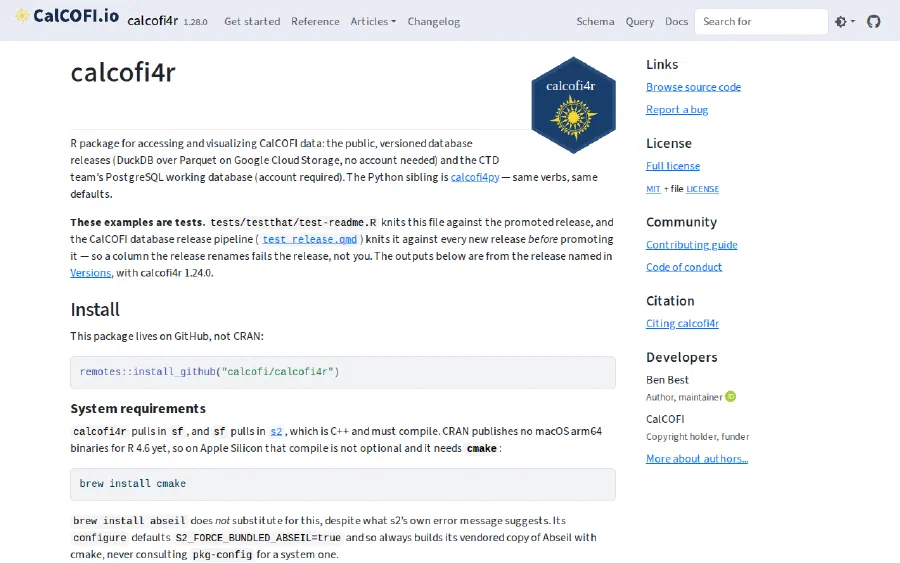
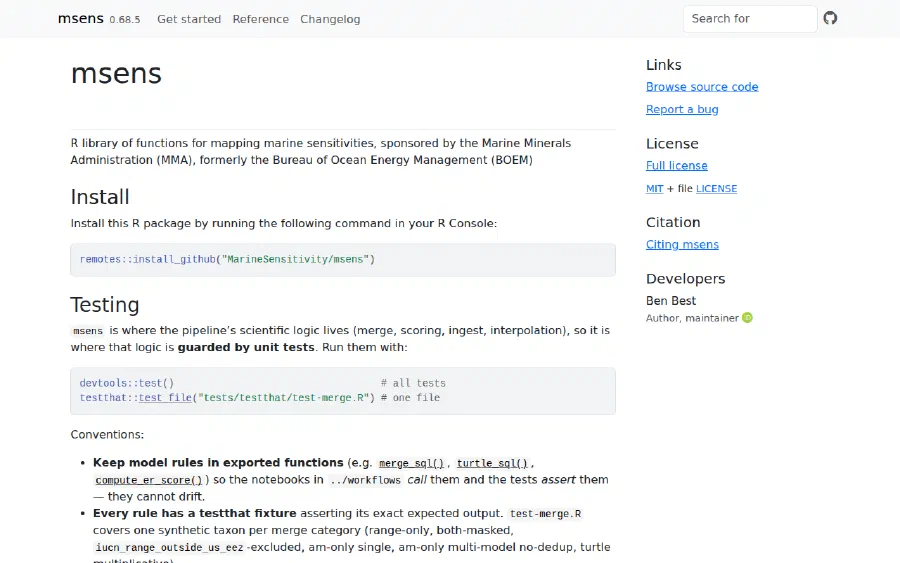
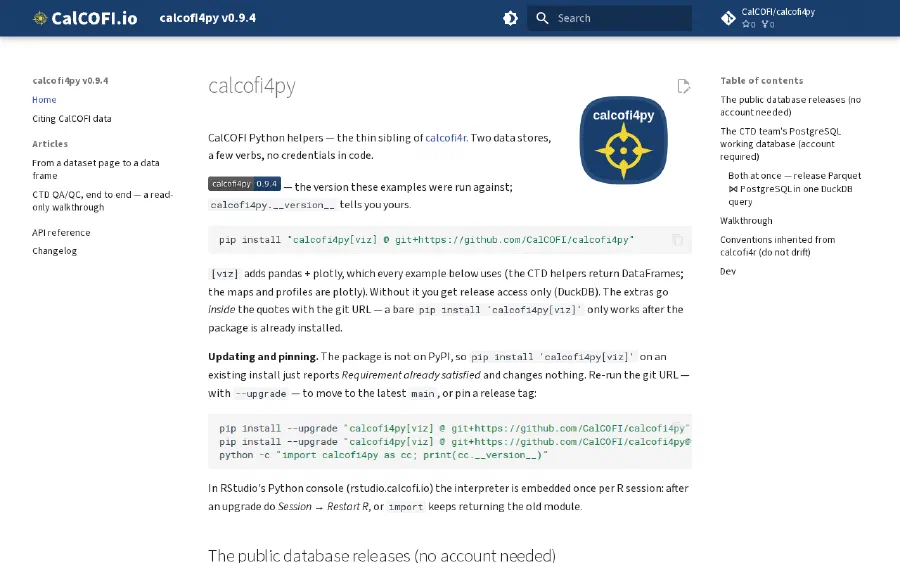
The Python twin of calcofi4r — access the public CalCOFI release through DuckDB over Parquet, plus the CTD PostgreSQL database.
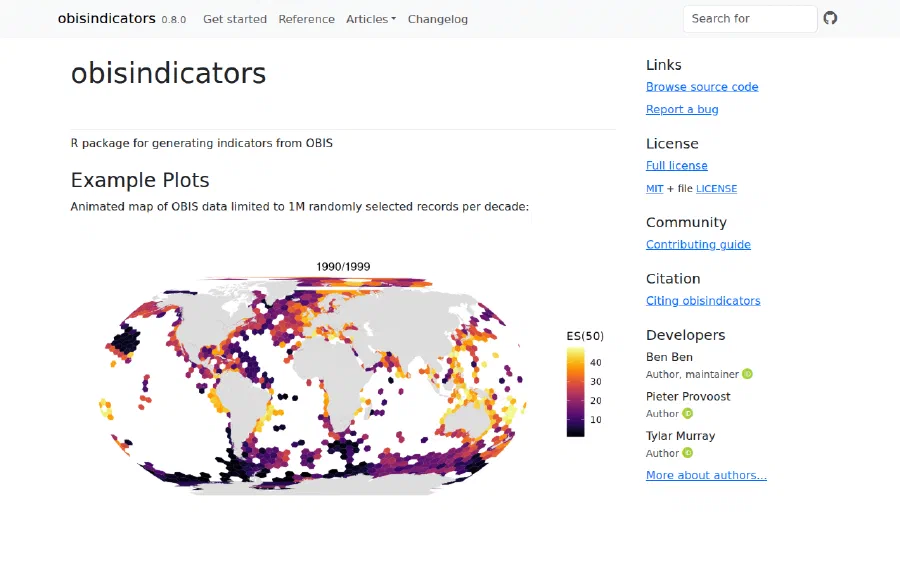
An R package that computes marine biodiversity indicators from OBIS and builds the monthly H3 release behind OBIS Hex.
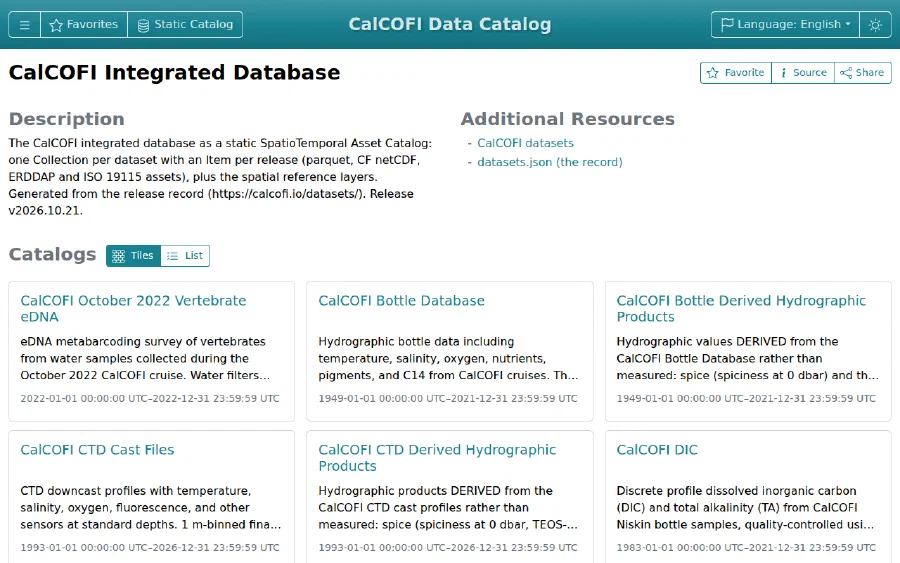
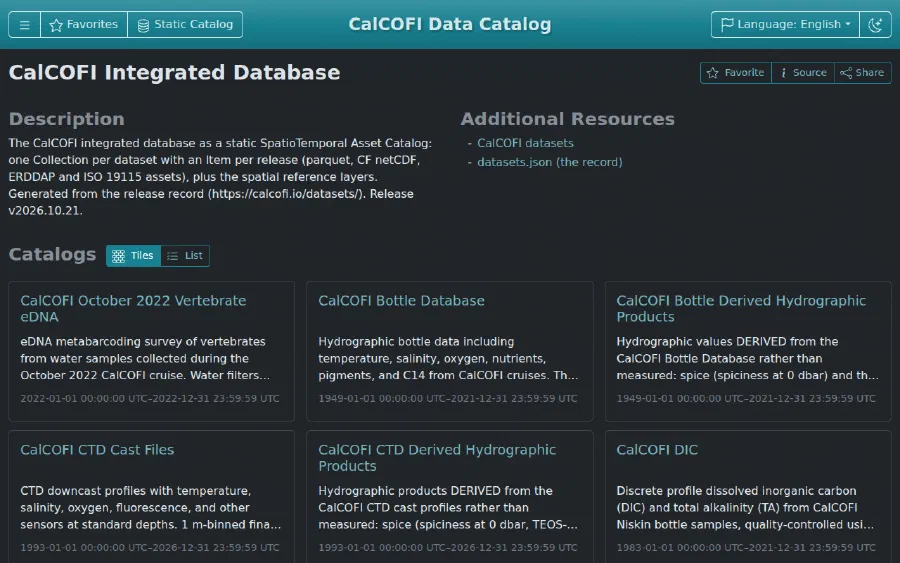
A STAC catalog of every CalCOFI dataset and spatial layer, one item per database release, browsable in the browser.
The static STAC catalog describing every Marine Sensitivity release at the dataset level.
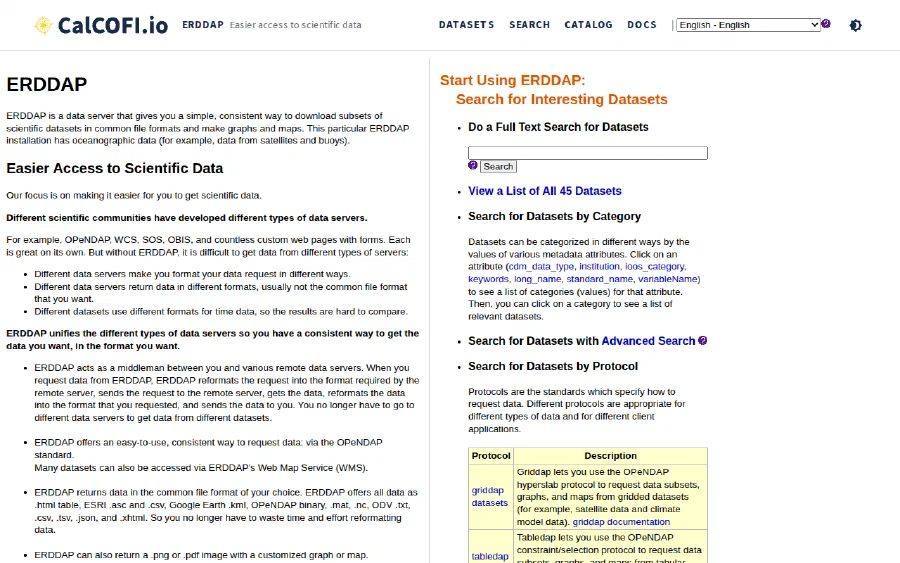
The CalCOFI datasets served through ERDDAP's tabledap and griddap interfaces, for the wider ocean-data community.
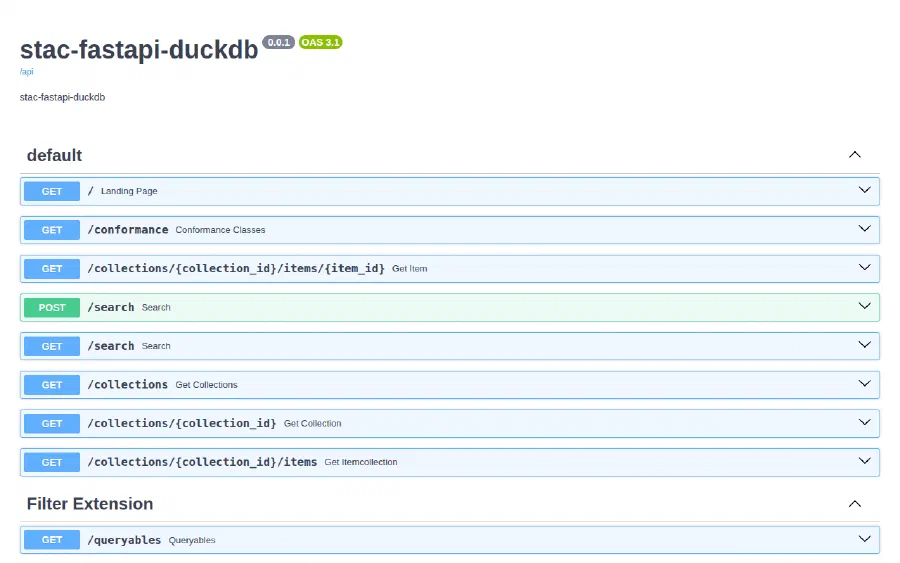
A searchable STAC API with one item per species model — ask which models cover an area and get the answer as STAC.
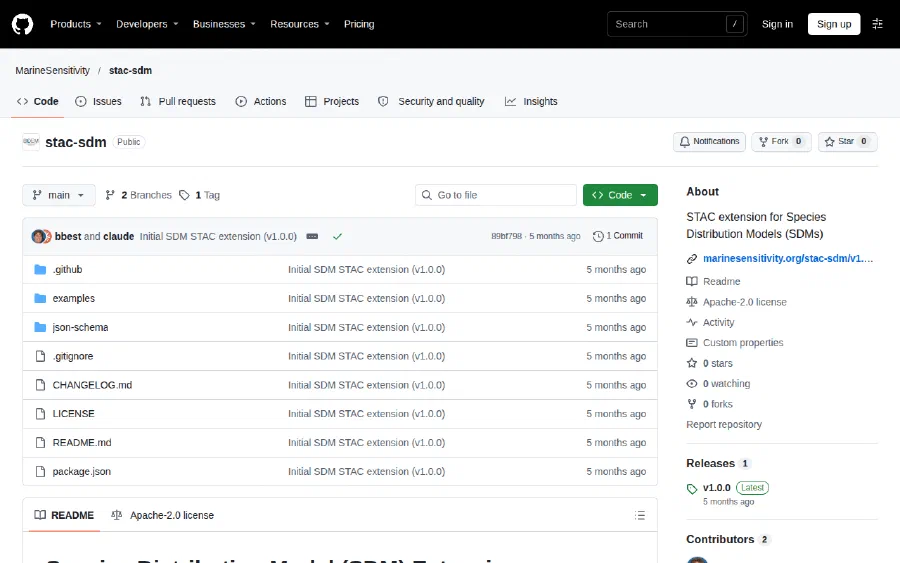
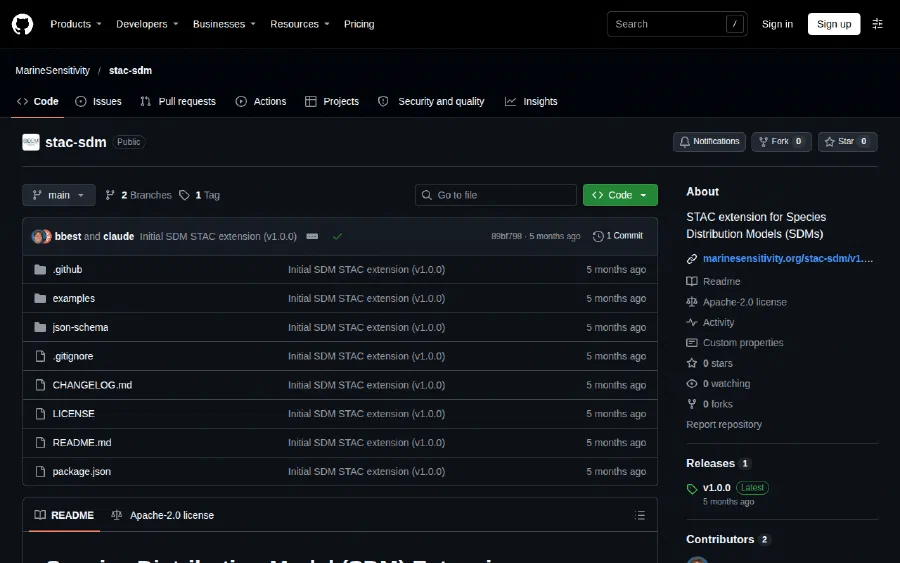
A proposed STAC extension for describing species distribution models — taxon, method, inputs and evaluation — as standard metadata.
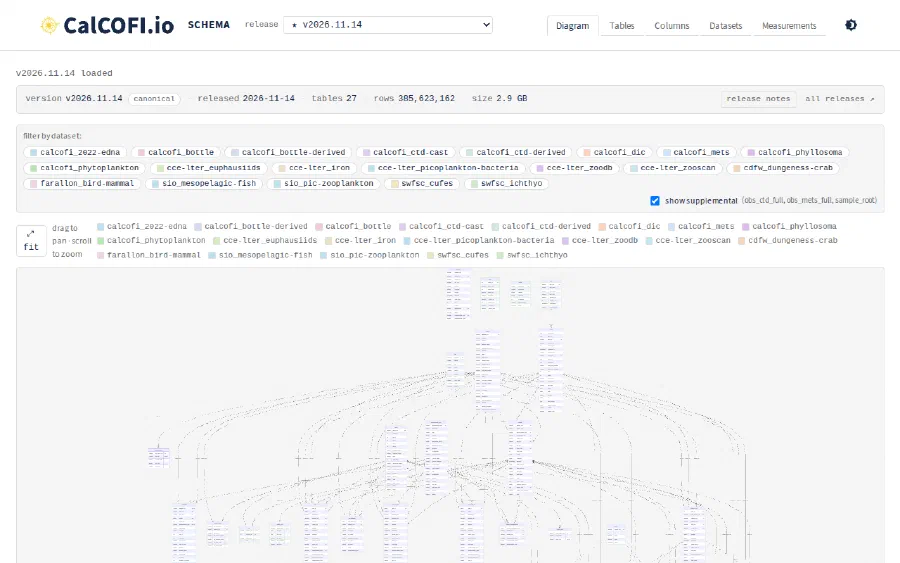
Browse every table, column and relationship of each CalCOFI database release, with entity-relationship diagrams.
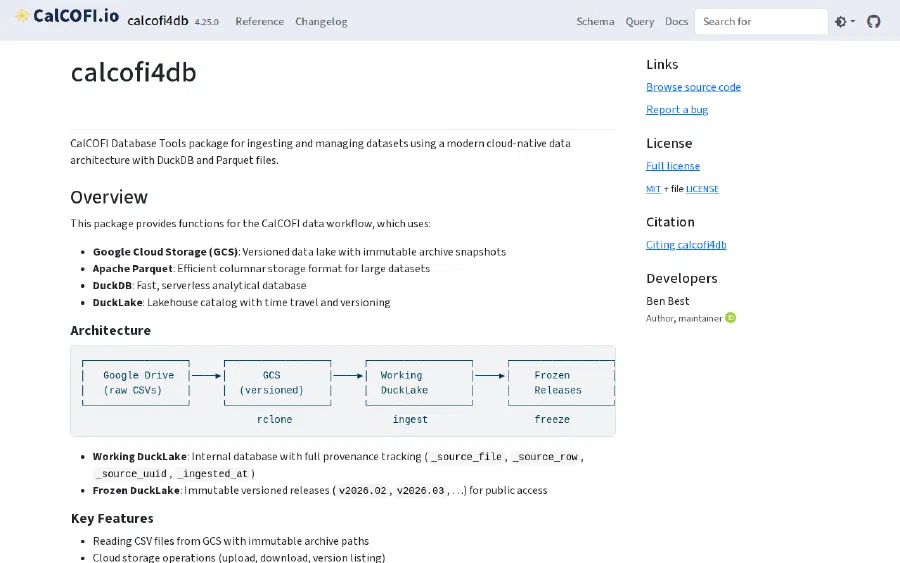
The builder's package — ingest every CalCOFI dataset, version the integrated database, and publish each release as Parquet and a STAC catalog.
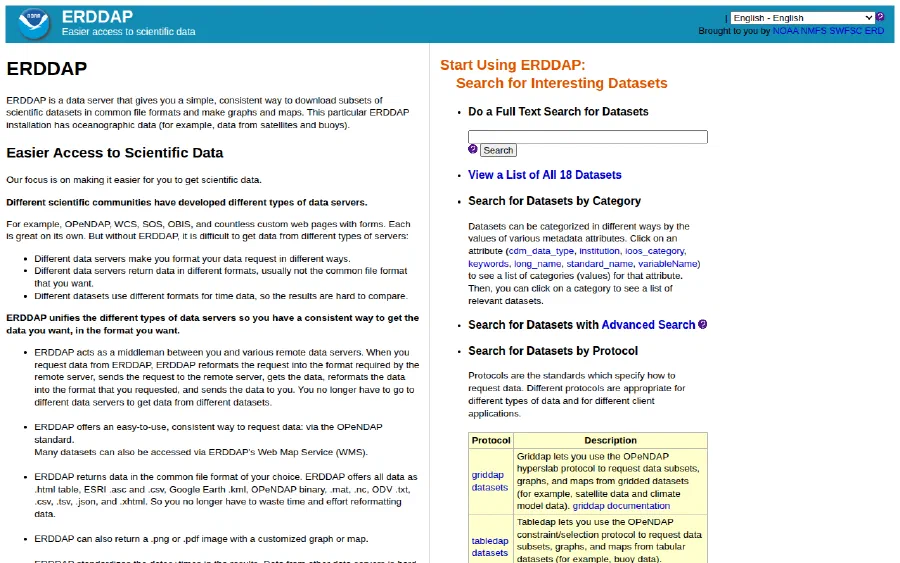
An ERDDAP with CORS and Parquet output that re-serves upstream NOAA datasets for browser-based apps.
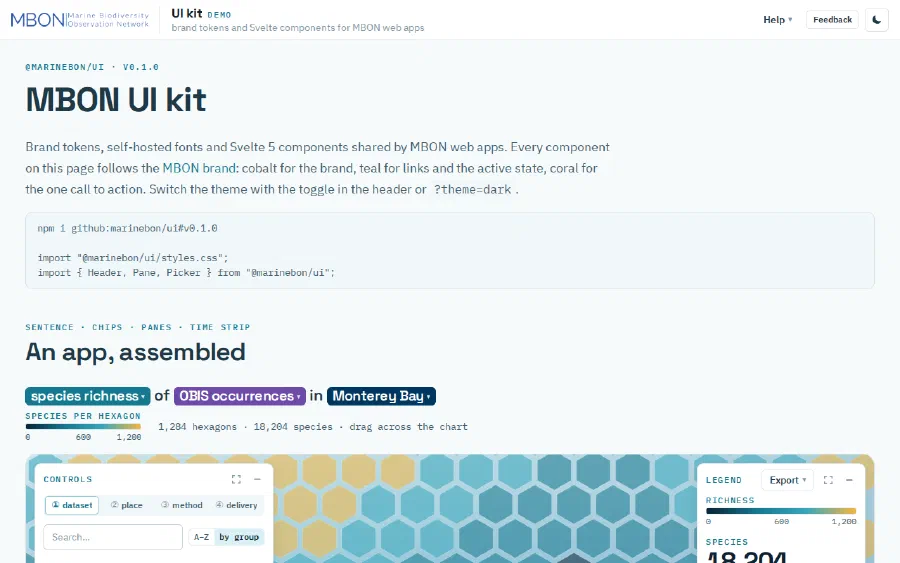
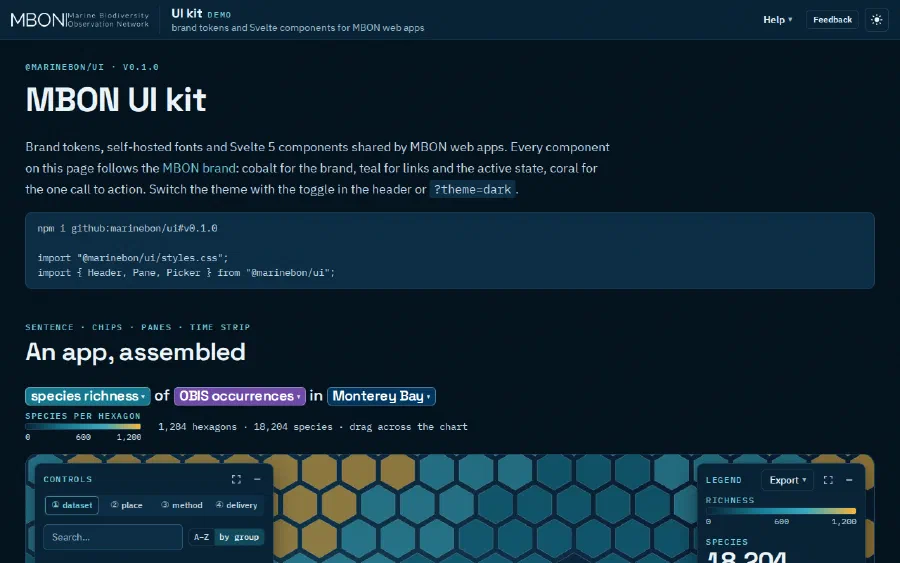
MBON brand tokens and Svelte components, with a demo site and Playwright screenshot tests.
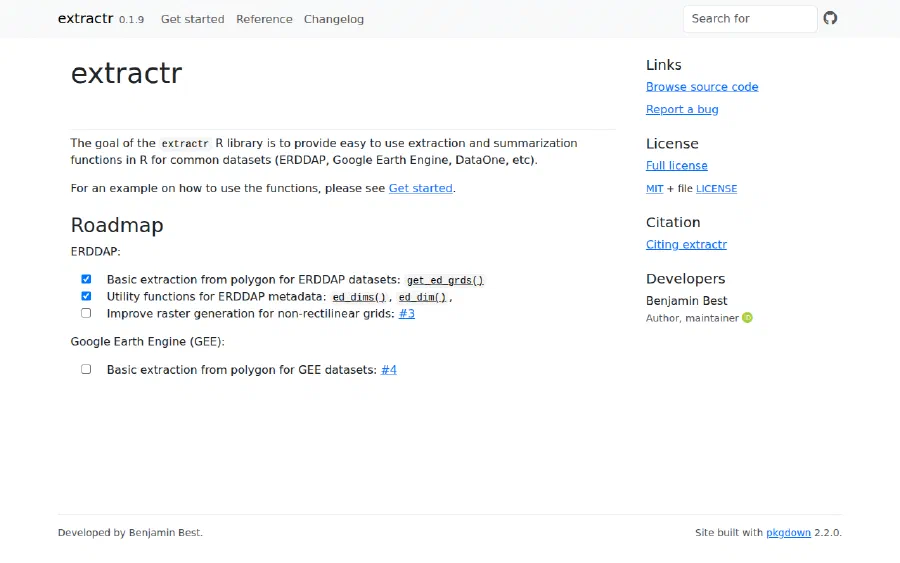
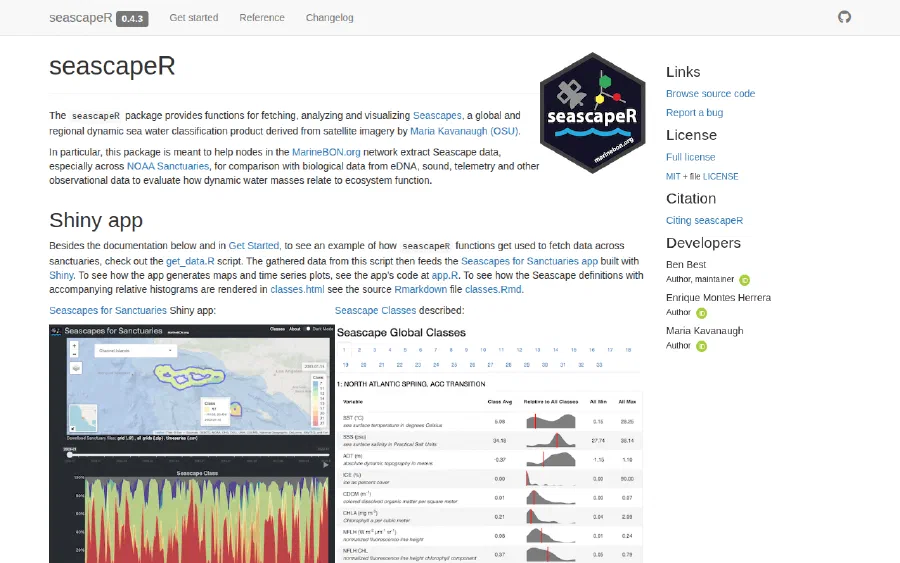
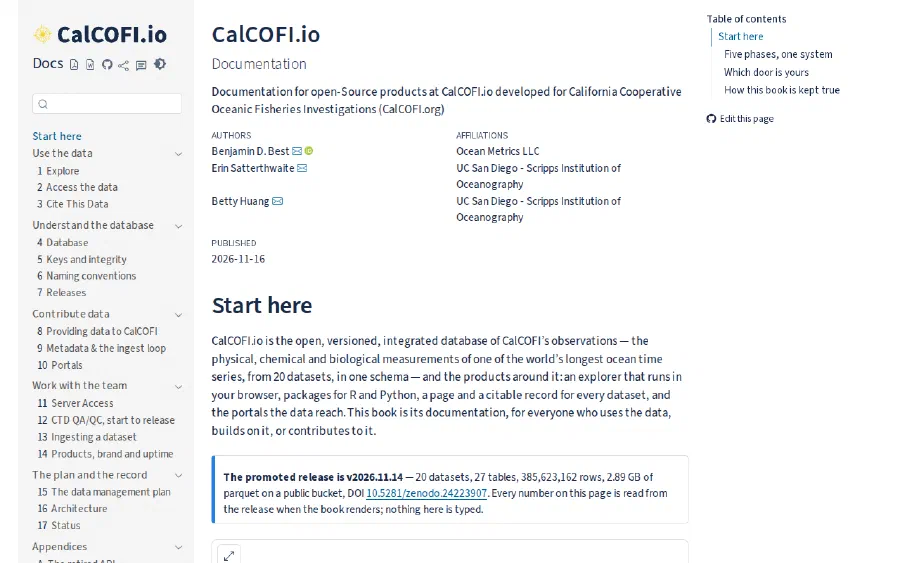
The Quarto book describing the CalCOFI data platform: architecture, database, data access, data-management plan and glossary.
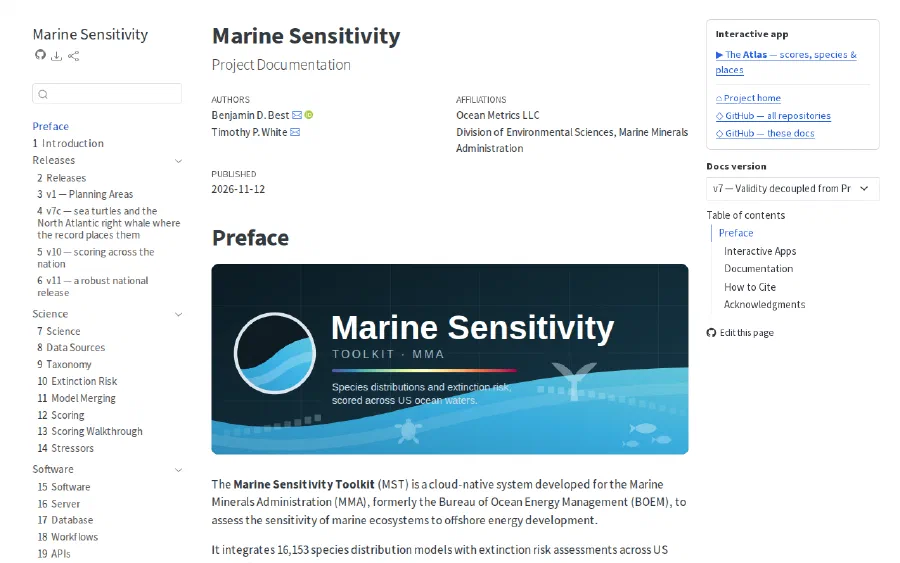
The versioned methods book — releases, apps, APIs, database and glossary — with PDF and DOCX downloads.
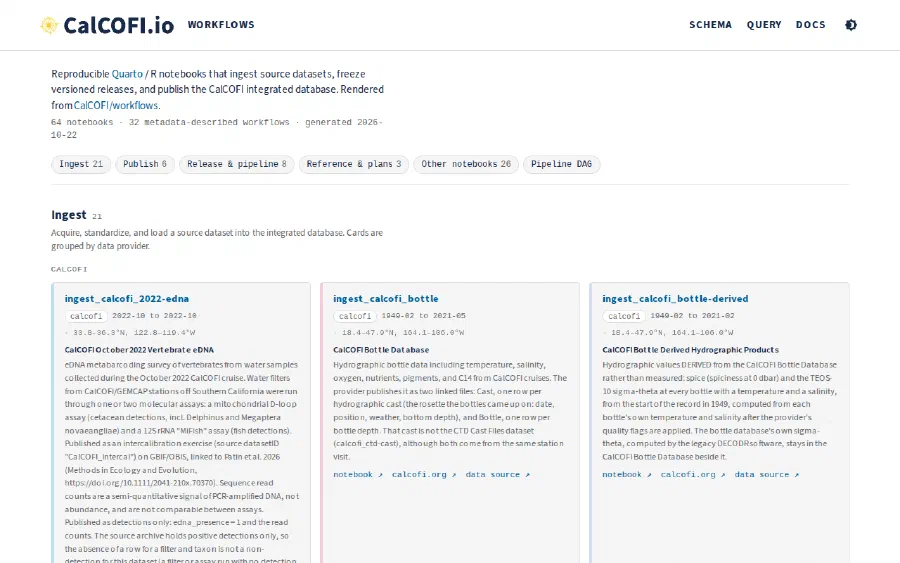
The reproducible notebooks that ingest every dataset and build each database release, published as rendered pages.
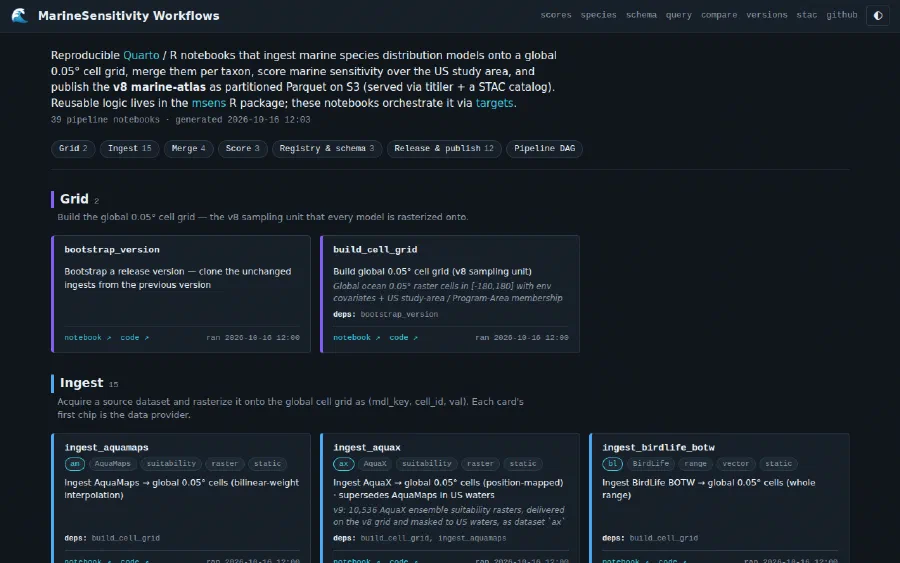
The reproducible notebooks that ingest species models, merge them, score them and publish each release.
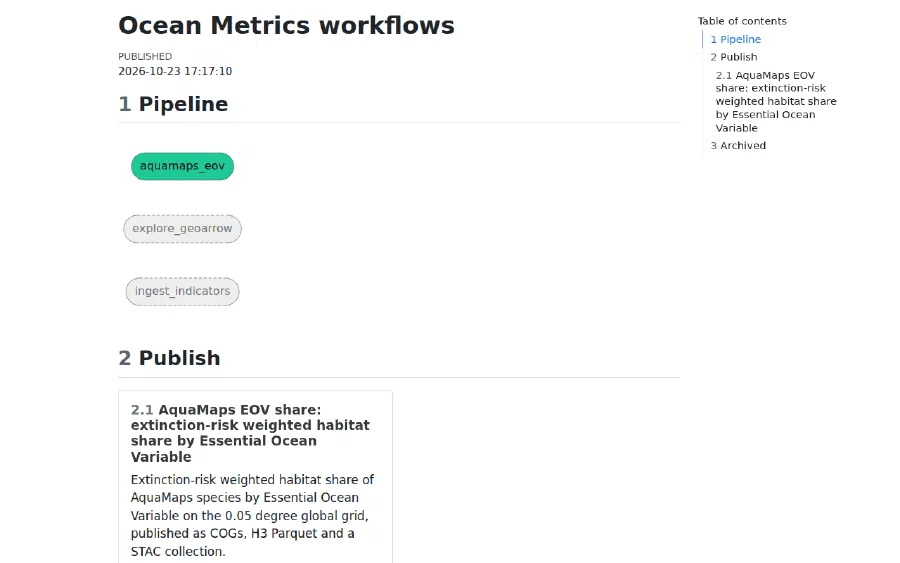
Studio notebooks: indicator ingest into PostGIS and PMTiles, GeoArrow experiments and STAC products.
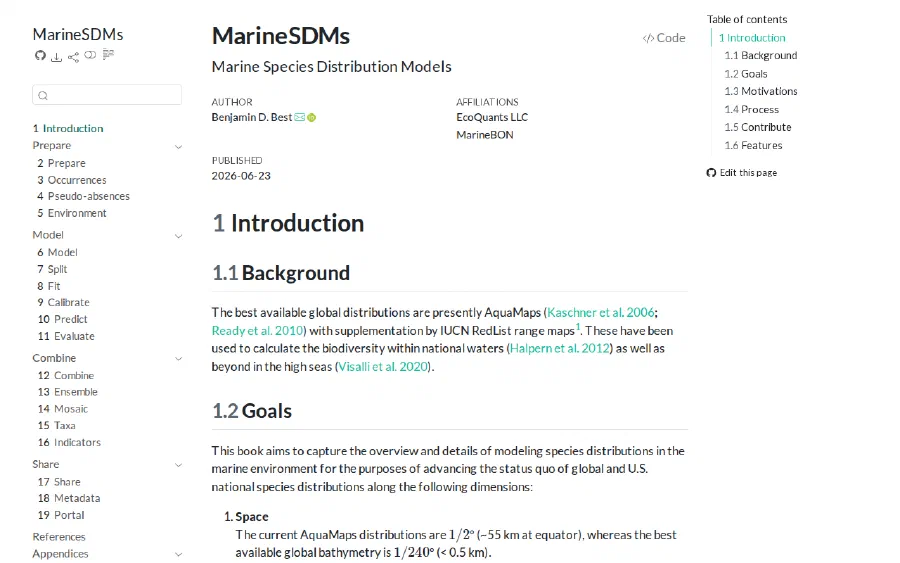
A Quarto book on species distribution modeling in the ocean, with worked examples in R.
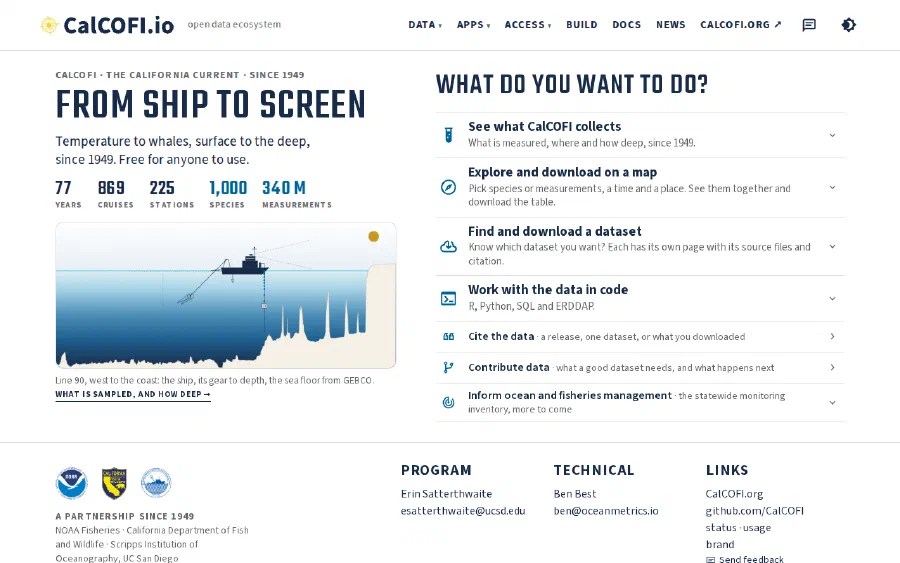
The front door to CalCOFI's open-data platform — datasets, apps, access, build and docs in one place.
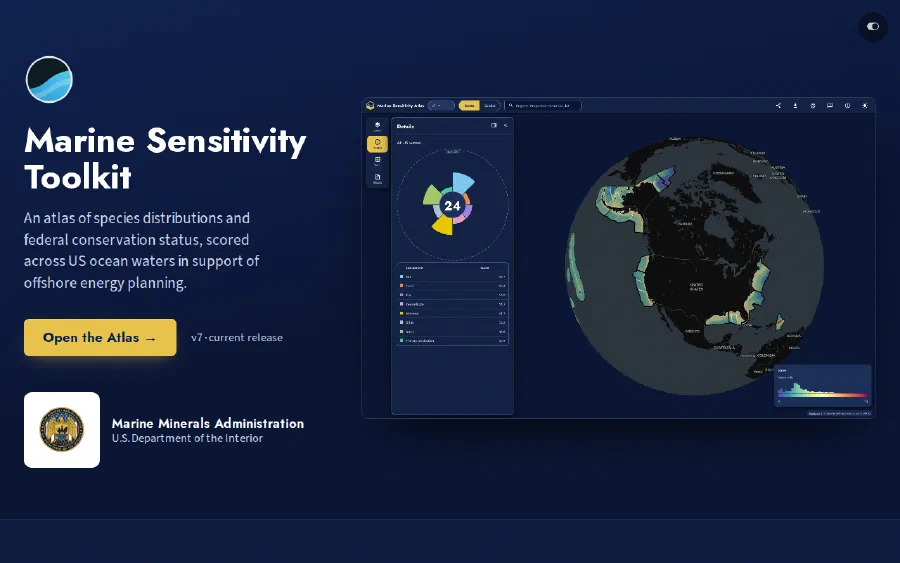
The project landing page for the BOEM Marine Sensitivity atlas, linking apps, docs and releases.
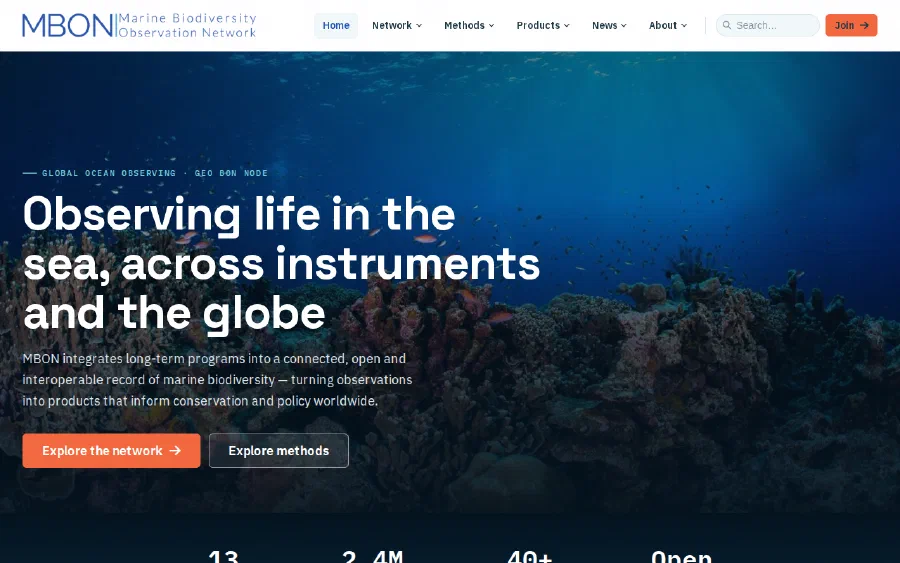
The U.S. Marine Biodiversity Observation Network hub — tools, datasets, methods, news and partners, with a tag-filtered catalog.
No tools match those filters.
36 tools. Status and screenshots refreshed 5 days ago by a scheduled job. Status is the date of the last commit to each tool's repository; screenshots are taken in light and dark themes.